
How much do we really know about the brain? Can what we know help us to think about teaching and learning? BSc Educational Psychology students at the University of Manchester provide summaries of research as easily accessible resources for understanding how neurology, biology and neuropsychology help us to understand and support pupils:
- Guide to Memory
- Guide to The Neuropsychology of ADHD
- Guide to Understanding and supporting children with ADHD.
- Guide to Understanding ADHD and Sustained Attention
Resources are designed to be easily downloaded and displayed within schools. To suggest a title or for more information, please contact michael.wigelsworh@manchester.ac.uk.
Teacher Guides to Conditions
Understanding common biological and neurobiological conditions can aid the planning and use of effective strategies to promote education.
Guide to Memory
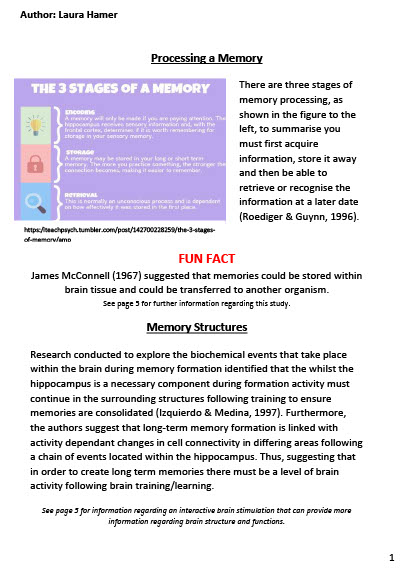
A guide to the processes involved in creating memories, with practical tips to help you support your students’ memory and learning capabilities.
The numerous, instantaneous processes taking place within your brain, enabling you to read this guide, are extraordinary.
Did you know that on average you have 70,000 thoughts every day, and over the span of your lifetime your brain will hold up to one quadrillion pieces of information? This guide will provide you with some insight into the types of memory, an individual has, the processes that create memories and how this impacts a child’s learning, along with some practical tips to aid in the learning process.
Learn more about Memory
Guide to The Neuropsychology of ADHD
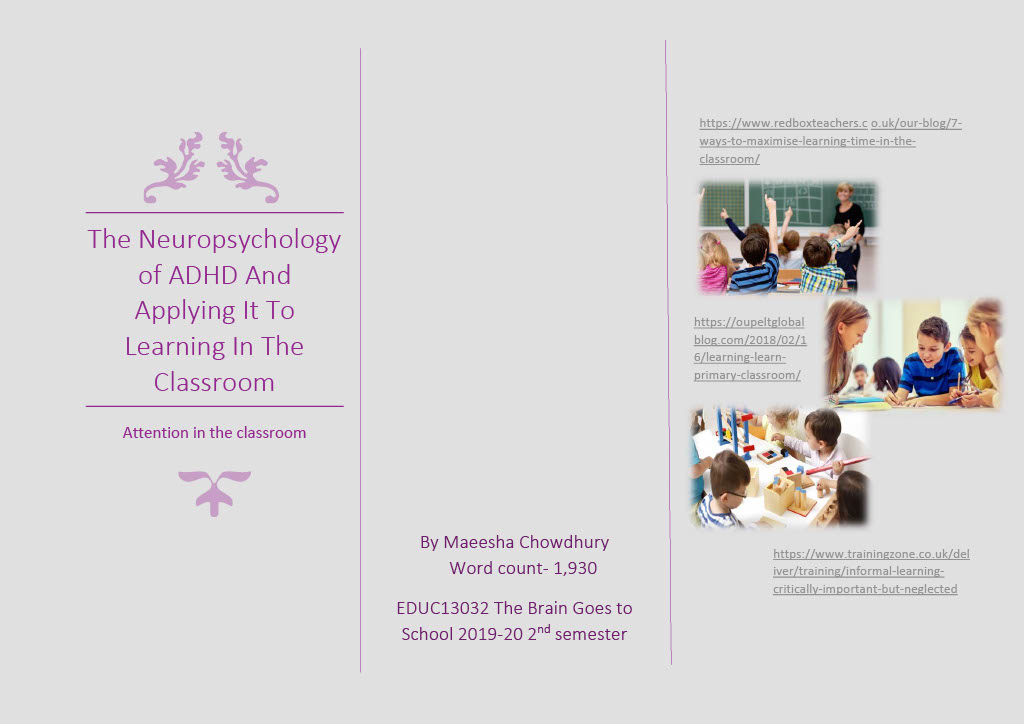
This guide aims to help teachers gain a better understanding of the brain of a child with ADHD (Attention Deficit Hyperactivity Disorder) and it will show how the component of attention in neuropsychology is applied to learning in a classroom setting. Students in both primary and secondary school are the focus of this guide and to be more specific, students with ADHD will be looked at to see how neurology can be applied to make learning more effective for such students. ADHD is said to have been on the rise in the UK over the past few years (Greenway & Edwards, 2020). One study found that the prevalence of prescribing ADHD medication increased between the years 2003-2008.
Learn More about the Neuropsychology of ADHD
Guide to Understanding and Supporting Children with ADHD
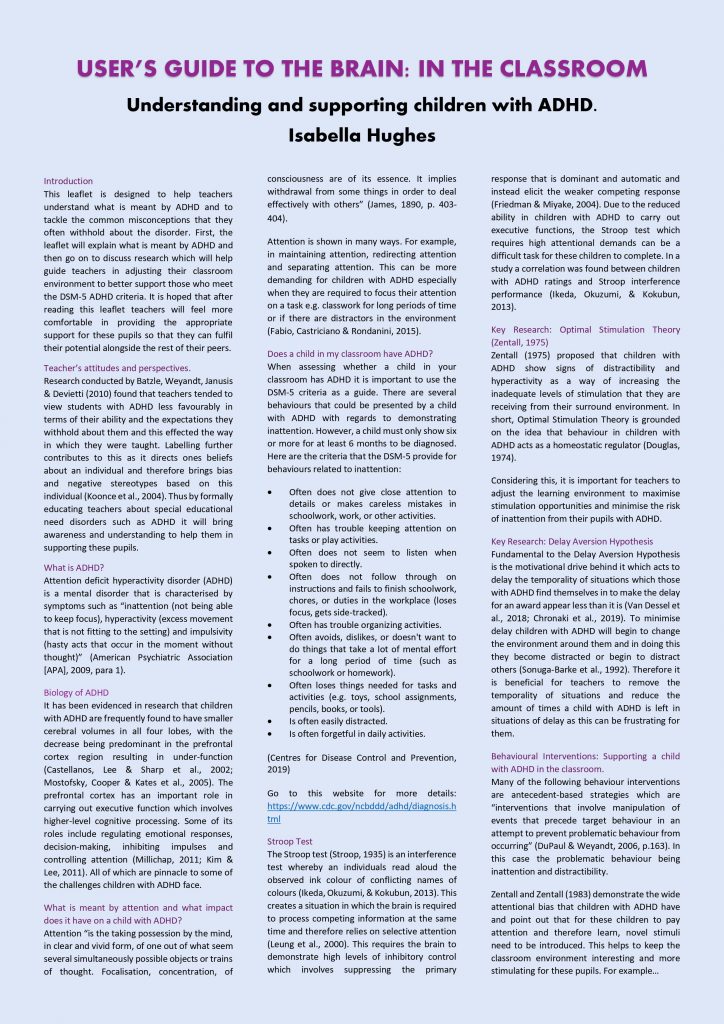
This leaflet is designed to help teachers understand what is meant by ADHD and to tackle the common misconceptions that they often withhold about the disorder. First, the leaflet will explain what is meant by ADHD and then go on to discuss research that will help guide teachers in adjusting their classroom environment to better support those who meet the DSM-5 ADHD criteria. It is hoped that after reading this leaflet teachers will feel more comfortable in providing the appropriate support for these pupils so that they can fulfil their potential alongside the rest of their peers. It has been evidenced in research that children with ADHD are frequently found to have smaller cerebral volumes in all four lobes, with the decrease being predominant in the prefrontal cortex region resulting in under-function. The prefrontal cortex has an important role in carrying out executive function which involves higher-level cognitive processing. Some of its roles include regulating emotional responses, decision-making, inhibiting impulses and controlling attention; some of the challenges children with ADHD face.
Learn more about Supporting Children with ADHD
Guide to Understanding ADHD and Sustained Attention
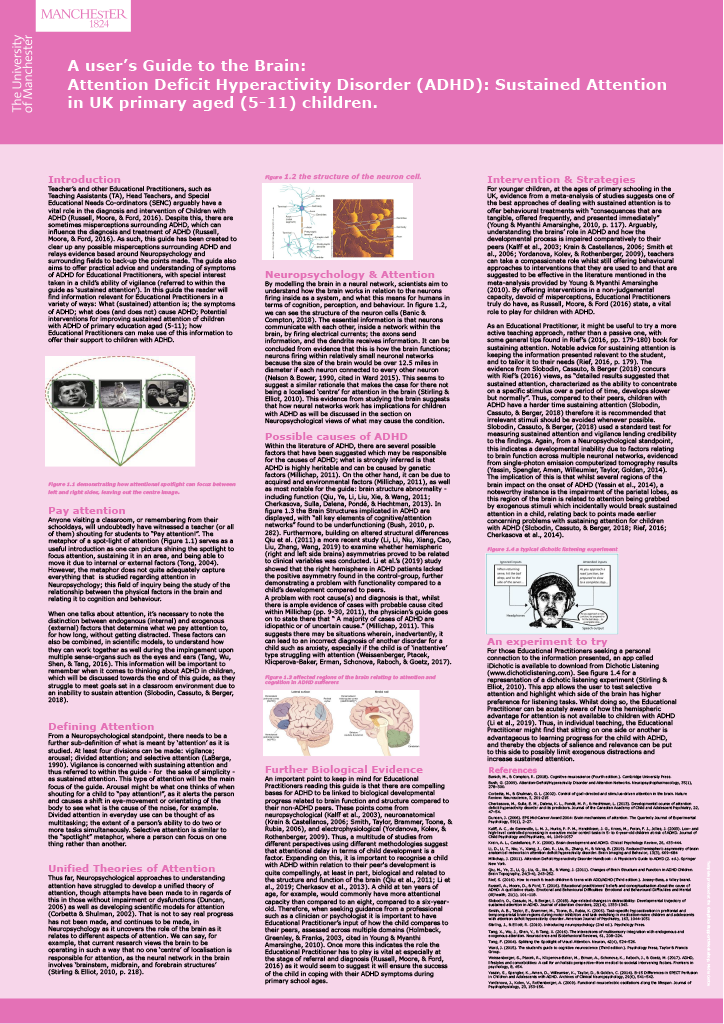
Teacher’s and other Educational Practitioners, such as Teaching Assistants (TA), Head Teachers, and Special Educational Needs Co-ordinators (SENCO) arguably have a vital role in the diagnosis and intervention of Children with ADHD. Despite this, there are sometimes misperceptions surrounding ADHD, which can influence the diagnosis and treatment of ADHD. As such, this guide has been created to clear up any possible misperceptions surrounding ADHD and relays evidence-based around Neuropsychology and surrounding fields to back up the points made. The guide also aims to offer practical advice and understanding of symptoms of ADHD for educational Practitioners, with a particular interest in a child’s ability of vigilance (referred to within the guide as ‘sustained attention’). In this guide the reader will find information relevant for Educational Practitioners in a variety of ways: What (sustained) attention is; the symptoms of ADHD; what does (and does not) cause
ADHD; Potential interventions for improving sustained attention of children with ADHD of primary education aged (5-11); how Educational Practitioners can make use of this information to offer their support to children with ADHD.
Learn more about Sustained Attention