

What can Psychology tell us about ourselves, how we relate to others, and how others relate to us? What relevance does this have for teaching and learning? BSc Educational Psychology students at the University of Manchester have created easily accessible summaries of key theories that can help us tackle common and enduring issues present in the classroom, for instance:
- Gender Stereotypes in the Classroom
- Getting Pupils Motivated
- How Interference can Affect Attention
- Influence of Teacher Expectations
- ‘Overlearning’ Explained and Preparing for Exams
- Self-Esteem in Education
- What does Psychology tell us about Bullying?
Further summaries are shown below.
Resources are designed to be easily downloaded and displayed within schools. To suggest a title or for more information, please contact Michael.Wigelsworth@manchester.ac.uk
Social Psychology Guides

Self
These guides relate to individual learner differences and experiences: the self.
Self-Esteem Movement in Education
- The rise and fall of the self-esteem movement in education
- Individual differences in motivation

Rise and Fall of Self-Esteem Theory
Self-esteem is the part of the construct known as “sense of self”. The other two parts are self-concept (the awareness of who I am) and ideal self (who I want to be). Self-esteem is basically the difference between these two concepts.
Self-esteem can be global and specific, and different areas of self-esteem are of different importance for people. Social context (people around us) is extremely important in developing self-esteem. Parents, teachers and peers are important sources of self-esteem of the student.
Learn More about the Self-Esteem Movement in Education
Individual Differences in Motivation

Pupil Motivation can be a tough act to balance, particularly around exam time. It is crucial for teachers to adjust their classrooms and teaching styles around a significant educational period such as GCSE season so that feelings of enthusiasm are maintained.
This poster is designed to help secondary school teachers prepare their students for their GCSEs.
Learn more about Pupil Motivation.
Group Behaviour
These guides relate to how groups are formed, typically behave, and their impact on the experience of school.
Gender Stereotypes in the Classroom
Gender stereotyping may involve oversimplified judgements of a
person, their abilities or their behaviour based on an image of what they believe people of their gender should be or act like. Many pupils may speak of their experiences of gender stereotyping in the classroom.
Learn more about Gender Stereotypes
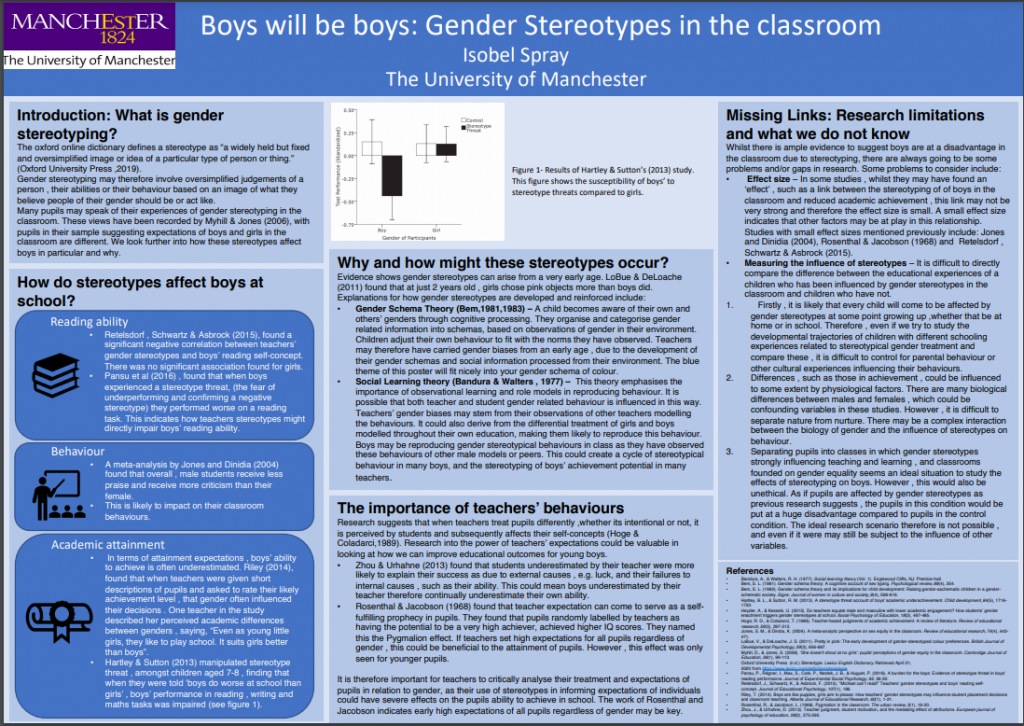
Gender Stereotypes by Isobel Spray
Influence of Teacher Expectations

Impact of Teachers’ Expectations on Pupils by Kyna Ho
Teachers’ beliefs and expectations of their students can influence teachers’ behaviours in the classroom which can subsequently affect students’ performance. This is known as the Pygmalion effect. Teachers who have a preconceived negative belief of a particular group of students may set lower expectations for them which can alter a teacher’s classroom practices.
Learn more about the Impact of Teacher Expectations
Teaching and learning
These guides summarise issues directly relating to teaching and learning, including the role of the teacher.
How Interference can affect Attention
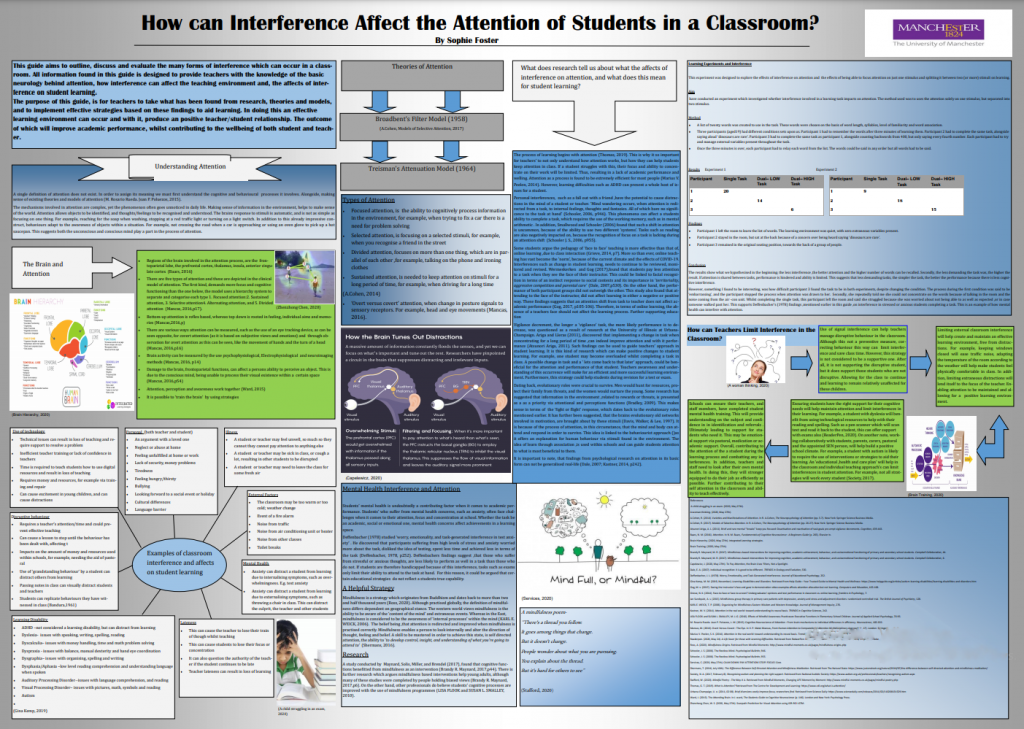
How Interference Can Affect Attention by Sophie Foster
Outlining and evaluating the many forms of interference which can occur in a classroom. This guide is designed to provide teachers with the knowledge of the basic neurology behind attention, how interference can affect the teaching environment and, the effects of interference on student learning. Offering effective strategies based on these findings to aid learning.
Learn more about the Impact of Interference on Attention
Overlearning and Preparing students for Exams

Overlearning Technique by Jack McGeehan
The academic experience of children today is more ‘test-orientated’ than ever whilst institutions could also be described as being ‘test-consuming’. Students are now aware from a young age that they will be assessed by their exam performance in all walks of life.
To perform at the highest level, a working understanding of the tools at your disposal is necessary. In this case, the tool is the brain and to get the most out of it, both teachers and their students must have an understanding of it and how it responds to methods of exam preparations. It is necessary for teachers to have and provide knowledge of which methods can be used to best master that information so that it may be more easily recalled under exam conditions. Overlearning; one method of gaining mastery of information that may be useful in preparation for these exams.
Learn more about Overlearning and preparing for exams
Whole School
These guides address issues relating to whole-school approaches.
What Psychology tells us about Bullying

What Psychology Tells us About Bullying by Bradley Sandell
Bullying is defined as an aggressive act inflicted on an individual by “one or more other persons”.
Psychological research indicates that up to 1 in 4 children may be involved in bullying; as the bully, victim, or both. Whilst rates vary due to contextual factors such as culture, the suggestion that bullying could be this prevalent indicates a genuine cause for concern. This resource is designed to aid Educational Practitioners in gaining insight into the nature of bullying, and how this relates to prevention and intervention strategies. Exploring competing socio-psychological models to discern the different roles involved in bullying.
Learn more about What Psychology Tells us about Bullying
Showcase
We have collated a short list of effective guides drawn across the other areas for those wishing to browse some of the best guides in the collection.